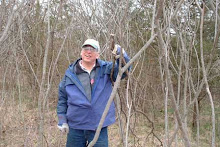
Stewardship events are a great way to get outdoors, meet new friends, and help the environment. Here are some opportunities.
Saturday, October 18 - collect seeds at Swift Run Park, 9:00 to noon; plant seeds at Mary Beth Doyle Park, 1:00 to 4:00 PM. (NAP)
Saturday, August 2, 2008


Friday, July 4, 2008
Crab spiders animate wildflowers

Among the tiny creatures that really run the world's ecosystems, crab spiders play an interesting role.
The dwell within wildflowers such as milkweed and goldenrod, and prey on insects that come to visit. Often they assume the coloration of the flower - magenta, yellow, or whatever.
In turn, they are preyed upon by pompilid wasps. (see photo.)
Here are a couple of sites:
A great invert blog from Michigan's Upper Peninsula has a nice page on crab spiders.
Windsor Ontario's Ojibway Nature Centre includes crab spiders on its spider page.
So far, I haven't spotted any in my wildflower photos. But I'll keep looking.
Monday, June 2, 2008
June 1 Dedication of Wetland Preserve

The Washtenaw County Drain Commissioner's new storm water detention project at the Mary Beth Doyle Park and Wetland Preserve was dedicated on June 1 This project uses native trees, shrubs, and herbacious plants as part of a project to slow the flow of Mallett's Creek and keep the waters cool for wildlife. (Click here for details.)
Quoting Mike Garfield:
"The park was renamed after Mary Beth Doyle, the Ecology Center's former Environmental Health Campaign Director, in memory of her remarkable work at the local, state, and national levels for environmental health, and of her energetic efforts to save green space and parks in Ann Arbor. Mary Beth ran the field campaign for the 1999 Ann Arbor parks millage campaign, and was a leader in the 2000 Washtenaw County natural areas campaign and 2003 Ann Arbor Greenbelt campaign.
"In the way that this park blends fun with environmental protection, it provides a fitting tribute to Mary Beth Doyle. She found humor in the toughest situations, and was a dogged defender of public health and the environment."
Monday, May 12, 2008
parasites carried by "commercial" bumble bees
A report from the National Academies on the Status of Pollinators
in North America says:
"One possible cause of decline in native bumble bees appears to be introduced parasites carried by bumble bees imported from Europe for greenhouse pollination. These bees frequently harbor disease organisms and their escape from greenhouses can lead to pathogen spillover into native species."
Read a summary here.
This is especially relevant in SE Michigan, because one of the world's largest commercial bee producers has a large operation in Romulus.
Koppert Biological, Inc. is a subsidiary of Koppert Biological Systems BV.
in North America says:
"One possible cause of decline in native bumble bees appears to be introduced parasites carried by bumble bees imported from Europe for greenhouse pollination. These bees frequently harbor disease organisms and their escape from greenhouses can lead to pathogen spillover into native species."
Read a summary here.
This is especially relevant in SE Michigan, because one of the world's largest commercial bee producers has a large operation in Romulus.
Koppert Biological, Inc. is a subsidiary of Koppert Biological Systems BV.
Saturday, May 10, 2008
Rain Garden planted on May 10
Volunteers and NAP staff built a rain garden at the Mary Beth Doyle Park and Wetland Preserve on May 10, 2008.

The new new rain garden is near the Packard entrance. It will capture storm water that runs off the small parking lot, and channel it to a basin that contains native plants with deep roots.

The new plants will increase diversity and attract birds and butterflies.

This sunny area is a pleasant contrast to the woods south of Mallets Creek where shade-loving flowers are thriving.

The new new rain garden is near the Packard entrance. It will capture storm water that runs off the small parking lot, and channel it to a basin that contains native plants with deep roots.

The new plants will increase diversity and attract birds and butterflies.

This sunny area is a pleasant contrast to the woods south of Mallets Creek where shade-loving flowers are thriving.
Tuesday, April 22, 2008
Mary Beth Doyle Nature Preserve
The Mary Beth Doyle Nature Preserve is in southeast Ann Arbor, Michigan, USA.
For Mapquest or similar program enter the street address: 2870 Packard Road, 48104.
In Topozone.com, enter lat/long as 42.2431 north 83.7073 west.
In Google Earth, enter as "42.2431 -83.7073" (Be sure to include the negative sign, or you'll end up viewing far north-west China.)
Here's an aerial photo from at least 4 years ago. This was before the condos were built on Cardinal Ave., along the northwest boundary.

For Mapquest or similar program enter the street address: 2870 Packard Road, 48104.
In Topozone.com, enter lat/long as 42.2431 north 83.7073 west.
In Google Earth, enter as "42.2431 -83.7073" (Be sure to include the negative sign, or you'll end up viewing far north-west China.)
Here's an aerial photo from at least 4 years ago. This was before the condos were built on Cardinal Ave., along the northwest boundary.

Monday, April 21, 2008
insects and milkweeds
Prof. Mark Hunter gave a fascinating presentation on "The Natural and Un-Natural History of Milkweeds: Insects, Toxins and Other Stories" at the combined meeting of the Michigan Botanical Club - Huron Valley Chapter and Wild Ones - Ann Arbor Chapter on Monday, April 21, at Matthei Botanical Gardens, 7:45 PM.
Many insects use milkweed blossoms. Native bees and wasps, butterflies and moths all feast on the nutritious nectar.

You may be aware that Monarch butterflies depend on milkweed as a larval host. That is, the adults lay eggs on milkweed leaves, and when the eggs hatch, caterpillars eat the leaves.
There's a nice overview on the Monarch Watch site.
Monarchs have evolved a way to deal with the specialized chemicals that milkweeds produce, and may use it to reduce the effects of a parasite (Ophryocystis elektroscirrha).
Many other species have evolved tolerance, including a specialized food chain of aphids, crab spiders, and pampilid wasps. Here's a milkweed beetle.

Many insects use milkweed blossoms. Native bees and wasps, butterflies and moths all feast on the nutritious nectar.

You may be aware that Monarch butterflies depend on milkweed as a larval host. That is, the adults lay eggs on milkweed leaves, and when the eggs hatch, caterpillars eat the leaves.
There's a nice overview on the Monarch Watch site.
Monarchs have evolved a way to deal with the specialized chemicals that milkweeds produce, and may use it to reduce the effects of a parasite (Ophryocystis elektroscirrha).
Many other species have evolved tolerance, including a specialized food chain of aphids, crab spiders, and pampilid wasps. Here's a milkweed beetle.

Subscribe to:
Posts (Atom)